A 30-day Instagram Reels test plan for small brands (no big budget needed)
Posting reels randomly and hoping one goes viral is not a strategy. Run a 30-day test instead: fixed formats, deliberate hooks and honest measurement. Here is the full plan.
In this post 8 sections
Most small brands treat Instagram Reels like a lottery: post something, check the views, feel bad, repeat. A better approach is to treat the next 30 days as an experiment. You decide in advance what you are testing, keep everything else steady, and judge results with numbers you write down.
This plan works for a home bakery, a skincare start-up, a coaching institute or a freelancer building a personal brand.
Know the current basics
- Instagram increased the maximum Reels length to 3 minutes in January 2025, up from 90 seconds. Longer is allowed, not required.
- Reels are recommended to people who do not follow you, so the first seconds decide whether a stranger keeps watching.
- Trial reels (available to professional accounts) show a reel to non-followers first, so you can test an idea without it appearing to your followers. Use them to test hooks.
- Instagram has said it favours original content in recommendations over reposted clips. Make your own; do not repost someone else's video with a caption.
Week 0: set up the experiment
Before you post, decide three things:
- One goal. Profile visits, follows, DMs ("PRICE" comments) or website clicks. Pick the one closest to a sale.
- Three content pillars. For a bakery: behind the scenes, customer moments, "how we make it". For a coaching institute: student results (with permission), quick concept explainers, campus life.
- A tracking sheet with columns: date, pillar, hook type, length, views, average watch time, shares, saves, follows, DMs.
The hook bank: test these five types
| Hook type | Example (home bakery) |
|---|---|
| Result first | Show the finished cake cut open, then "Here is how we get this texture." |
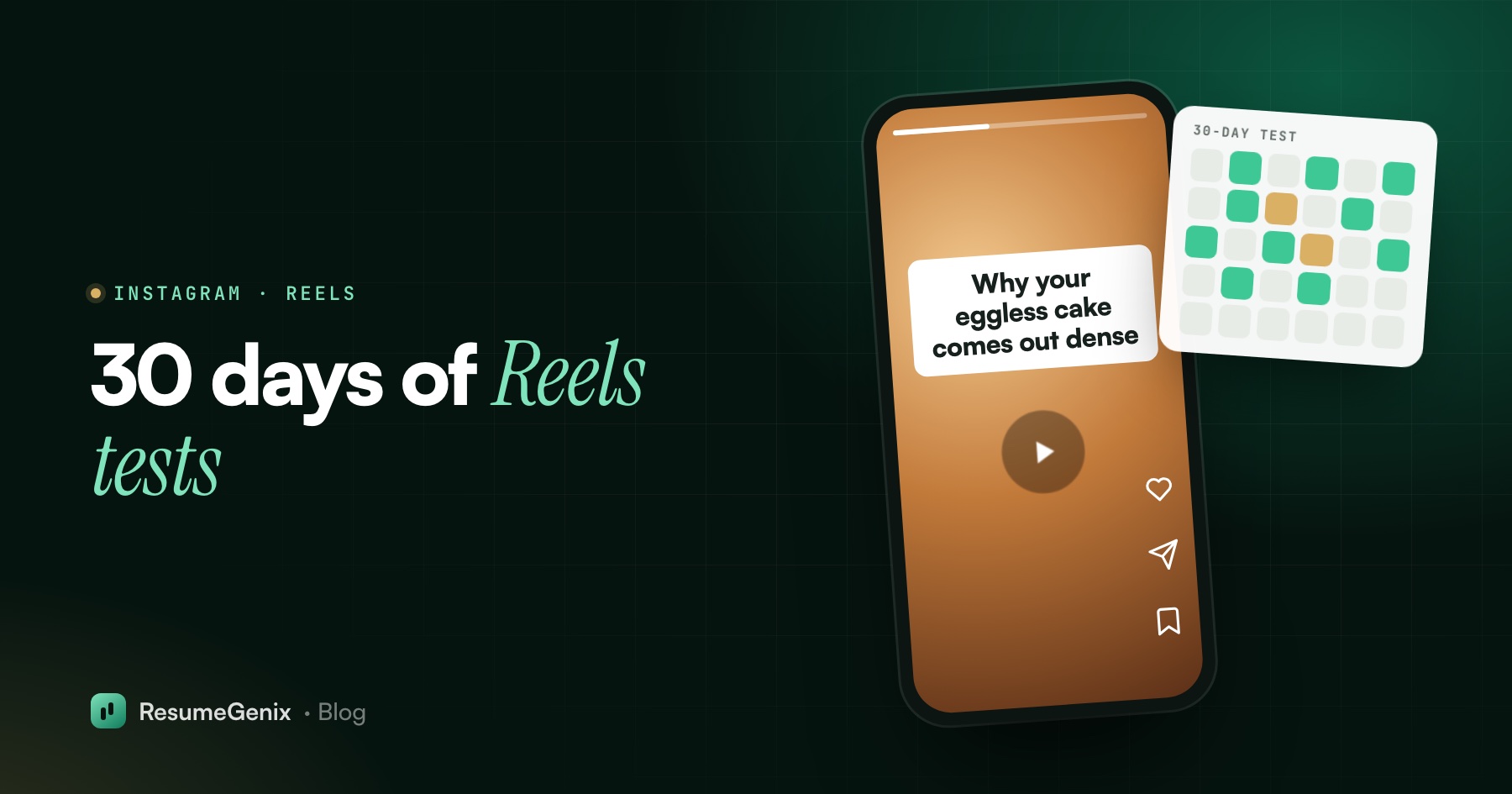
| Problem | "Why your eggless cake always comes out dense." |
| Surprising fact | "This cake has no maida. Here is what we use instead." |
| Person talking | The founder on camera: "We get asked this every day…" |
| Process | Fast cuts from batter to box, no talking, with on-screen text. |
Put text on screen in the first second, because many people watch on mute, and keep it inside the central safe area so the caption and buttons do not cover it.
Weeks 1 to 3: post on a fixed rhythm
Aim for 4 reels a week (12 in total). Rotate pillars and hook types so each hook type is tested at least twice. Keep the other variables steady: similar length (15 to 40 seconds is a sensible start), similar posting time, similar caption style.
- Use 1 to 2 trial reels a week to test a riskier hook before posting it normally.
- Reply to every comment in the first hour; reply to some with a video reply.
- Share each reel to your story with a poll or question sticker, so followers see it too.
- Do not boost anything yet. You are learning what works organically first.
What to measure (and what to ignore)
Views alone can mislead: one lucky reel can hide eleven weak ones. In Insights, look at:
- Average watch time and retention: where in the reel people leave. If most drop in the first 2 seconds, fix the hook. If they drop in the middle, cut the slow bit.
- Shares and saves per 1,000 views: the clearest sign that content is genuinely useful or entertaining.
- Follows and profile visits from the reel: did it bring you new people who care?
- DMs and link clicks: the actions closest to revenue.
Ignore likes as a success signal, and ignore any single reel's views in isolation. Look at averages per hook type and per pillar.
Week 4: decide, double down, then put money behind winners
- Rank hook types and pillars by shares and saves per 1,000 views, and by follows.
- Keep the top 2 hook types and top 2 pillars. Drop the rest for now.
- Make 3 new versions of your best reel: same idea, new opening, different length.
- If you have a small ad budget, run your best organic reel as an ad to a broad audience in your city. Content that worked organically usually makes a better ad than something made only for ads.
Common mistakes to avoid
- Trending audio with no link to your product. A trend only helps if it fits your message.
- Long intros: "Hi guys, welcome back to my page…" Start with the interesting part.
- Changing everything every day, so you cannot tell what caused what.
- Quitting after a week. Twelve reels is the minimum to see a pattern.
Turn it into a portfolio piece
If you are a student or freelancer, run this plan for a local brand or your own page and document it: the goal, your hook bank, the tracking sheet, the winners and what you would do next. That is a real social media case study, and it gives you a strong story for interviews. Practise telling it with our interview prep or book a 1:1 mock interview with a mentor.
Free for digital marketing students: resume builder, portfolio, courses, certificates and a job tracker.
Keep reading
 Meta Ads
 in 2026: Advantage+ vs manual targeting, and when each one wins
Meta keeps pushing automation, and many students are told 'just go broad'. That advice is right more often than not, but not always. Here is how to decide, and how to test it properly.
Read post ResumeGenix Weekly
 #1: three AI guides, a free ATS check and your first prompt
Welcome to the first ResumeGenix Weekly. This week: where to find fresher openings, a free ATS check for your resume, a Reel hooks prompt you can use today, and GA4 key events in two minutes.
Read post WhatsApp marketing
 for D2C brands: opt-in, templates and per-message pricing
WhatsApp is the most personal channel an Indian brand has, which is exactly why it is easy to misuse. Learn how opt-in, template categories and per-message pricing work before you blast a broadcast.
Read post