Your first Google Ads search campaign: a ₹500-a-day plan for beginners
Most first campaigns waste money in week one for the same three reasons: broad keywords with no negatives, one weak ad, and no conversion tracking. Here is a small, careful plan you can run on ₹500 a day.
In this post 8 sections
- Before you open Google Ads: decide one goal
- Set up conversion tracking first, not later
- Choose 10 to 20 keywords with clear intent
- Write one strong responsive search ad per ad group
- Quality Score: what it is and what it is not
- Negative keywords: your biggest money saver
- The ₹500-a-day test plan
- What to put in your portfolio
Most first Google Ads campaigns lose money in the first week for the same three reasons: keywords that are too broad with no negative keywords, a single weak ad, and no conversion tracking, so nobody knows what worked. None of these need a big budget to fix. They need a plan.
This guide walks through a small search campaign you can run on about ₹500 a day for a local business, a D2C brand or a practice project. Every rule below comes from Google Ads Help, and we link to the source pages so you can check them yourself.
Before you open Google Ads: decide one goal
A search campaign should do one job. Pick one of these and write it down:
- Leads: a form fill, a call or a WhatsApp click.
- Sales: a completed purchase on the website.
- Store visits or calls: for a clinic, salon, coaching centre or restaurant.
Then decide what one result is worth. If a coaching institute closes 1 in 10 enquiries and a student pays ₹20,000, an enquiry is worth up to ₹2,000 before costs. That number tells you whether a ₹300 cost per lead is good or terrible. Without it, you are guessing.
Set up conversion tracking first, not later
If Google cannot see conversions, it cannot learn which searches bring buyers, and you cannot judge the campaign. Before you spend a rupee:
- Create a conversion action in Google Ads (Goals → Conversions), or import key events from GA4.
- Test it yourself: submit the form or click the call button, and check that the conversion shows up (it can take a few hours).
- Mark only real business results as primary conversions. A page view is not a conversion.
Choose 10 to 20 keywords with clear intent
Good beginner keywords sound like someone ready to act: "digital marketing course in jaipur fees", "buy cold pressed coconut oil online", "dentist near vaishali nagar". Weak ones are research questions like "what is digital marketing".
Use Keyword Planner (inside Google Ads, free) to check that people actually search for your phrases and to see the suggested bid range. Group keywords that mean the same thing into one ad group, so one ad can speak to all of them.
Match types in plain words
| Match type | How you write it | What it does |
|---|---|---|
| Broad | coconut oil | Shows for searches related to the meaning, including ones without your words. Works best with Smart Bidding and good conversion data. |
| Phrase | "coconut oil" | Shows for searches that include the meaning of your phrase. |
| Exact | [coconut oil] | Shows for searches with the same meaning or intent. |
On a small budget with no conversion history, start with phrase and exact. Broad match can work well, but it needs data and a bidding strategy that uses it. Read Google's match type guide before you switch.
Write one strong responsive search ad per ad group
A responsive search ad (RSA) lets you write up to 15 headlines (30 characters each) and 4 descriptions (90 characters each), and Google tests combinations (source). Writing 15 near-copies of the same line wastes that. Mix these:
- The keyword itself (2 to 3 headlines): "Cold Pressed Coconut Oil".
- The proof: "Lab-Tested Every Batch", "4.6★ on 1,200 Reviews" (only if true).
- The offer: "Free Delivery Above ₹499", "Free Demo Class This Week".
- The objection killer: "COD Available", "No Hidden Fees".
- The action: "Order on WhatsApp", "Book a Free Counselling Call".
Pin sparingly. Pinning a headline to position 1 gives you control but cuts the combinations Google can test. Add sitelinks, callouts and a call asset too: they take more space on the page at no extra cost per impression.
Quality Score: what it is and what it is not
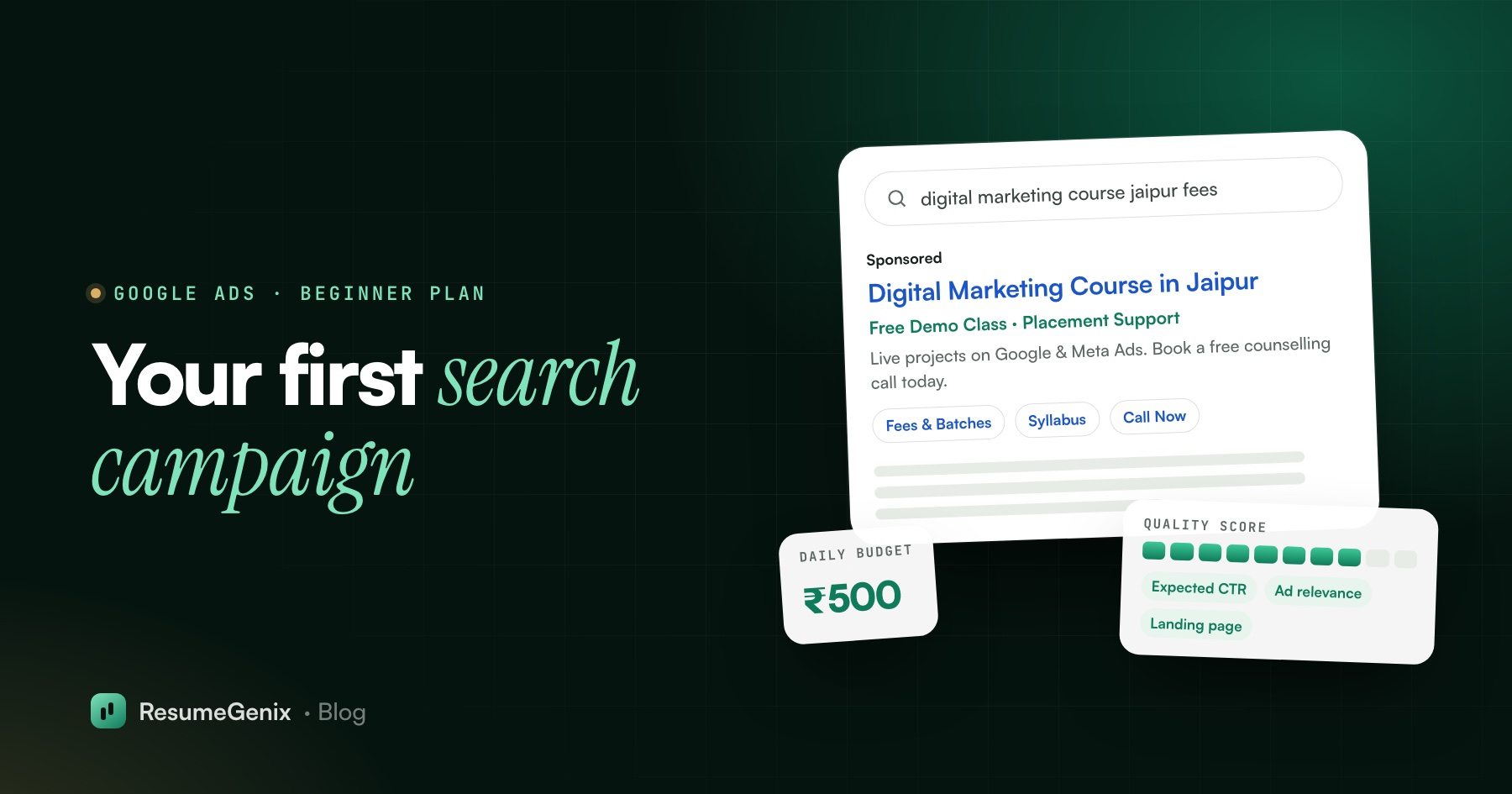
Quality Score is a 1 to 10 rating at keyword level, built from three parts: expected click-through rate, ad relevance and landing page experience, each shown as above average, average or below average (source).
Two things beginners get wrong:
- Quality Score is a diagnostic tool, not a direct input to the auction. Google uses real-time versions of the same signals at auction time.
- Your bid does not change your Quality Score. Raising the bid will not fix a below-average landing page.
The fastest fixes: put the keyword in a headline, make sure the landing page answers the search (price, location, what happens next) and make the page load quickly on a phone.
Negative keywords: your biggest money saver
Negatives stop your ad from showing on searches you do not want. Add these on day one, then add more every few days from the search terms report:
- Job seekers: jobs, vacancy, salary, internship (unless you are hiring).
- Free hunters: free, pdf, download (if you sell a paid product).
- Wrong intent: how to make, DIY, meaning, wikipedia.
- Wrong place: other cities you do not serve.
The ₹500-a-day test plan
| Days | What to do |
|---|---|
| Day 1 | Launch 1 campaign, 2 to 3 ad groups, 1 RSA each, phrase and exact keywords, location set to "presence" (people in your area). Bidding: Maximise clicks with a max CPC cap, or Maximise conversions if tracking already has history. |
| Days 2 to 4 | Check the search terms report every day. Add negatives. Do not change bids or ads yet. |
| Days 5 to 10 | Pause keywords with spend and zero conversions that clearly do not match intent. Check the ad strength and asset ratings, and replace the weakest headlines. |
| Days 11 to 14 | Compare cost per conversion with the value you worked out at the start. Keep and scale what is under that number; cut what is not. |
₹500 a day is about ₹7,000 over two weeks. That is enough to learn which keywords and messages work, not enough to "scale". Treat it as paid research.
What to put in your portfolio
If you ran this as a student project or for a small client, document it as a case study: the goal, what one result was worth, the keyword groups, two ad versions, the negatives you found, and the before and after numbers. Recruiters care much more about your reasoning than a big spend figure. You can turn it into a portfolio project in the builder and practise explaining it in a mock interview.
The best beginner campaign is not the one with the most keywords. It is the one where you can explain every rupee.
Free for digital marketing students: resume builder, portfolio, courses, certificates and a job tracker.
Keep reading
 Meta Ads
 in 2026: Advantage+ vs manual targeting, and when each one wins
Meta keeps pushing automation, and many students are told 'just go broad'. That advice is right more often than not, but not always. Here is how to decide, and how to test it properly.
Read post ResumeGenix Weekly
 #1: three AI guides, a free ATS check and your first prompt
Welcome to the first ResumeGenix Weekly. This week: where to find fresher openings, a free ATS check for your resume, a Reel hooks prompt you can use today, and GA4 key events in two minutes.
Read post Instagram
A 30-day Instagram Reels test plan for small brands (no big budget needed)
Posting reels randomly and hoping one goes viral is not a strategy. Run a 30-day test instead: fixed formats, deliberate hooks and honest measurement. Here is the full plan.
Read post